
Criminal Cases in Plumas County Courts
The Superior Court of California, County of Plumas is the local trial court for adult misdemeanor and felony prosecutions. Its Criminal Department files, processes, and maintains those records. California does not send felony cases to a separate district court. Fine-only traffic and citation matters can surface through payment-oriented channels, but the Superior Court remains the key custodian once criminal charges are filed.
The public counter is the Clerk's Office in Room 104 at 520 Main Street, Quincy, CA 95971. Criminal and traffic questions go to (530) 283-6232. Department 1 is on the third floor, while Departments 2 and 3 are on the first. A department number identifies the courtroom assignment, not a separate repository.
Plumas Criminal Department Holds Both Levels
The court's Criminal Department page confirms that one department maintains both misdemeanor and felony files. That matters when a charge changes level, as may happen with a California “wobbler,” an offense that can be treated as either a felony or misdemeanor under Penal Code section 17(b).
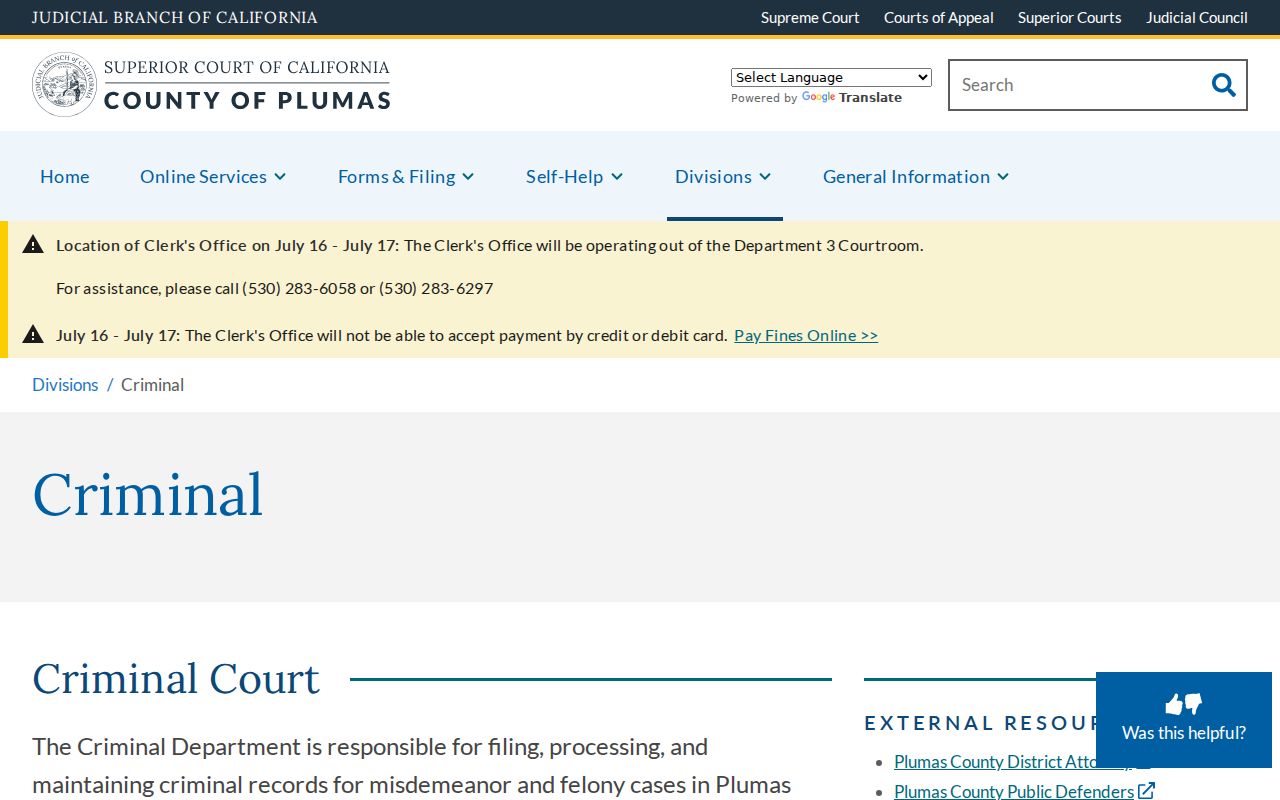
The court page is the best first check for the proper office before requesting a file. It also helps keep the court case separate from the arrest report, which the clerk does not supply.
How to Search Plumas County Case Records
Plumas County offers several court access paths. ePay-it is useful when a case or ticket may be payable. The online record request eForm is better for a written research or copy request. Mail and in-person requests remain available when the online route is not suitable. Fax and phone record-search requests are not accepted.
- Try ePay-it with an exact case or ticket number when one is known.
- Otherwise use the name and date-of-birth tab to distinguish people with similar names.
- Submit the court eForm or PDF request when a docket view does not provide the needed document.
- Select the complaint, disposition, sentencing order, protective order, or another specific public item.
- Ask the Room 104 clerk for copies or certification and allow the stated processing period.
| Field Label | Type | Required | Notes |
|---|---|---|---|
| Search tab | Tab | Yes | Case or Ticket Number; Name and Date of Birth; Vehicle Plate |
| Case or Ticket Number | Text | In that tab | Use the exact number. |
| First and Last Name | Text | In name tab | Middle name is optional. |
| Date of Birth | Date/text | In name tab | Helps separate matching names. |
| Vehicle Plate | Text | In plate tab | Used for plate-linked matters. |
Plumas Court Requests Avoid Wrong Records
The online record request eForm separates current contact data, requester details, record research, copy choices, and a preview. It warns that juvenile files are confidential, sealed files need a court order, and destroyed or purged records may no longer exist under Government Code section 68152.
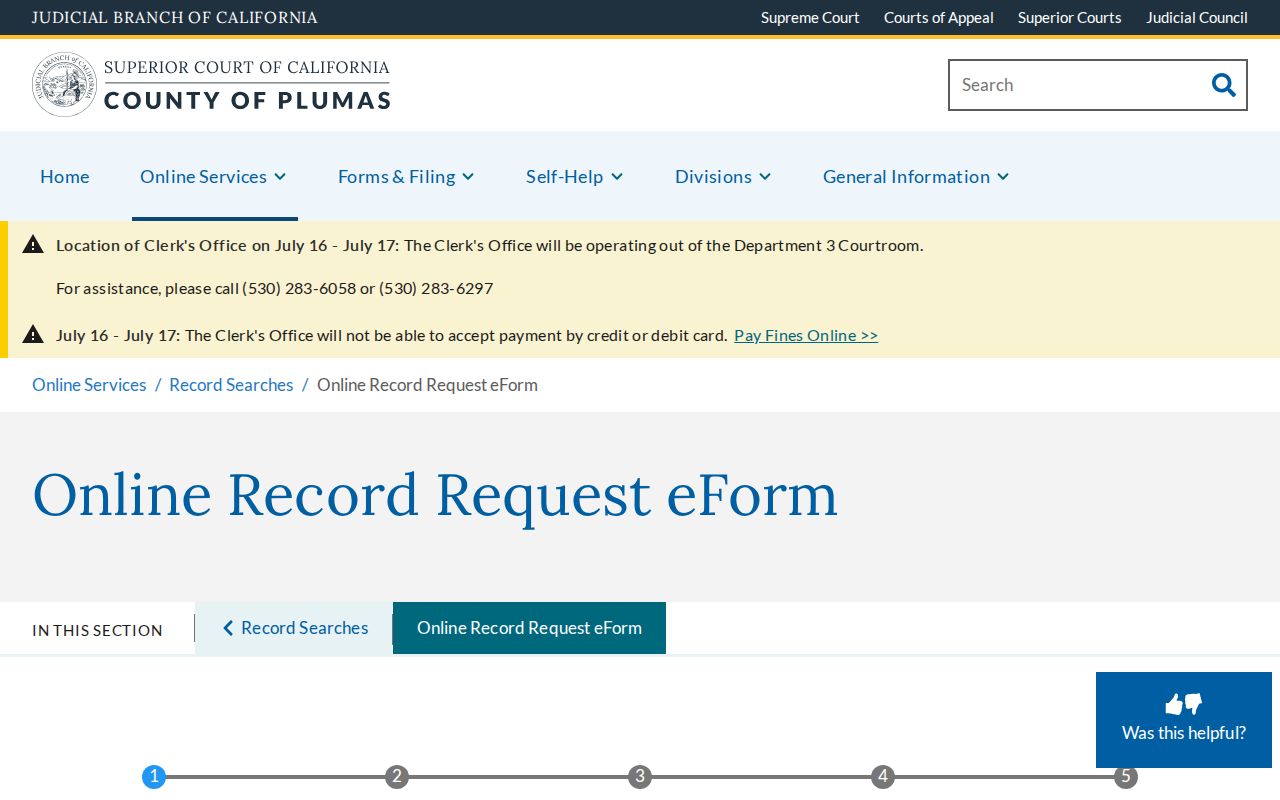
Choose the document, not merely “everything,” when the goal is a plea, sentence, or final outcome. The court form expressly excludes police, arrest, and incident reports, transcripts, warrants, and confidential documents. Those limits prevent a common routing error.
What Plumas County Case Files Show
A court file documents the prosecution after filing. It is not the fingerprint-based California DOJ rap sheet and is not the jail intake record. The most useful item depends on the question. The complaint identifies filed accusations; the docket traces court events; the disposition and judgment show the result; and the sentencing order states the court's terms.
| Case Number & Court | Identifies the Plumas file and assigned court department. |
|---|---|
| Charging Document | Complaint, information, or citation stating filed counts. |
| Docket Entries | Chronological register of hearings, filings, motions, and orders. |
| Hearing Dates | Arraignment and later scheduled appearances recorded by the clerk. |
| Disposition & Judgment | Conviction, plea, dismissal, acquittal, waiver, or diversion result. |
| Sentence & Conditions | Jail, probation, fines, restitution, or protective terms when public. |
Plumas Court Copies at Room 104
Walk-in users reach the clerk through the courthouse location instructions. The court location page identifies the clerk route, courtroom floors, and operating location.
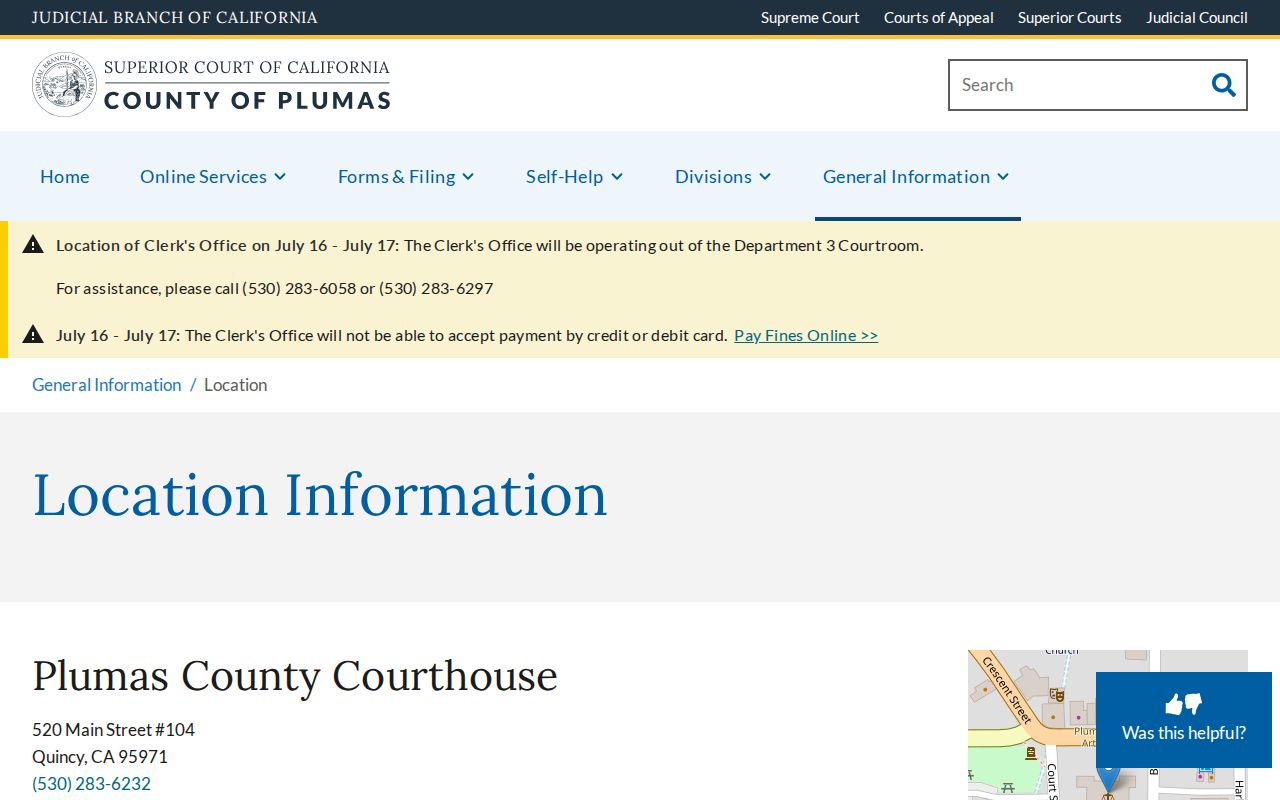
The clerk may pull no more than ten cases per customer, request, and transaction. Some files are stored off-site, so a second visit may be needed. Written requests usually take five to seven court business days. A public search that exceeds ten minutes costs $15; the fee is returned when the search takes ten minutes or less. Copies cost 50 cents per page, and certification costs $40 per document.
Stages of a Plumas County Criminal Case
An arrest or citation precedes the court file. The District Attorney reviews the facts, then a complaint, information, or citation starts the filed case. Arraignment is the first hearing where charges and plea issues are addressed. Pretrial conferences, motions, and a felony preliminary hearing may follow. The case then ends by plea, trial, dismissal, or diversion, with sentencing after a conviction.
Case flow: Charges Filed › Arraignment › Pretrial › Plea or Trial › Disposition › Sentencing
Plumas Alternative Sentencing Program staff may interview arrested people for pretrial release and court-referred participants for programs such as Proposition 47 diversion, AB 1810 mental health diversion, and Drug Court. A completed program can change the disposition shown in the file.
Plumas Court Records in a 1921 Landmark
The court's courthouse history places today's criminal clerk functions inside a long local timeline. The current Beaux Arts courthouse dates to 1921, while the county's court history reaches much further back.
That history has a practical effect. Older Plumas County criminal court cases may be off-site or subject to lawful retention and purge schedules. A missing online result is not proof that no case existed.
Plumas Court Clerk Is Not Clerk-Recorder
The Plumas County Clerk-Recorder page represents a county office, but it is not the Superior Court clerk who maintains criminal case files.
Send criminal docket and copy requests to Room 104, not the Clerk-Recorder counter in Room 102. This small office distinction prevents delays, especially for mailed requests that include a return envelope and research fee.
Plumas Case Record Access and Restrictions
Plumas court files are generally open unless a law or order makes them confidential. Juvenile files are confidential. Sealed files require a court order for access, and protected victim details, financial data, medical information, and other sensitive identifiers may be redacted. Government Code section 68152 also permits routine destruction after set retention periods.
The California Public Records Act governs many agency records, but court-file access follows judicial rules and statutes as well. Penal Code section 11105 separately restricts DOJ summary criminal histories. If a case is absent online, ask the clerk whether it is off-site, sealed, confidential, or purged. Do not assume the online view is the full paper record.
A dismissal also needs careful reading. Penal Code section 1203.4 can permit eligible defendants to withdraw a plea and obtain dismissal after completion, but it does not erase the file from every system. The court request form includes a specific checkbox for a PC 1203.4 order. That order is often the clearest proof of what the court granted. If California DOJ still shows an old or incomplete result, review your own fingerprint record through DOJ and follow its challenge process. The Superior Court can provide certified disposition documents, but it does not directly edit the Attorney General's master record.
Mail users should give enough detail to locate the right Plumas County case. Include the case number when known, the case name, date of birth, requester contact information, and the exact documents sought. Add a self-addressed stamped envelope and the applicable research fee. A vague name-only request may take more time and can match the wrong person. Photo identification may be required to inspect some records at the counter.